
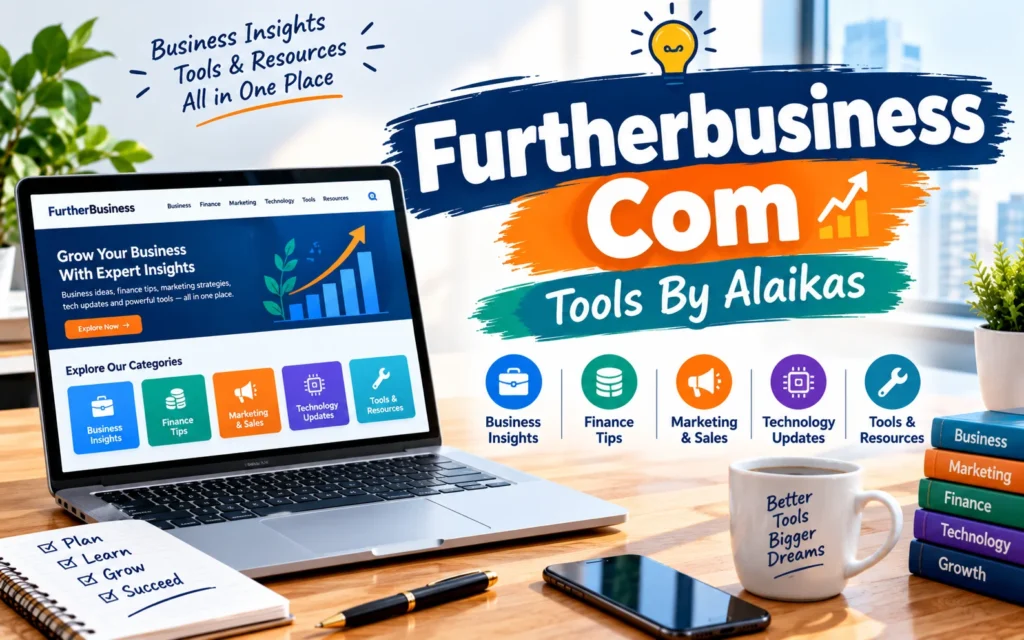
Furtherbusiness Com is a free, business-focused blog covering marketing, finance, and tools for small founders. It’s low-risk to browse, but treat it as a starting point for ideas, not the final word on any decision.
Every few weeks a new “dot-com” name starts trending in search, and everyone asks the same thing: is this a goldmine or a time-waster? Furtherbusiness Com is one of those names. Below is what it is, what it publishes, where it’s strong, where it’s thin, and a scorecard you can reuse on any business site.
What Is Furtherbusiness Com?
Furtherbusiness Com is a content website. It isn’t a store, a SaaS product, or a course platform. It publishes short guides and tips on marketing, finance, tools, and general growth for founders and small business owners, aiming for simple, actionable ideas rather than theory-heavy articles.
Search this keyword and you’ll hit a maze of third-party write-ups, several with near-identical names. Some are enthusiastic, some cautious. One review describes the site as relatively new or lesser-known, without an established reputation in business media. That’s a fair caution, and it shapes how I recommend using it.
Quick definition: a domain-review keyword is a search term that’s just a website’s name. People type it because they’ve seen the site somewhere and want to know whether to trust it. Such keywords are specific and driven by real user curiosity.
What Furtherbusiness Com Covers
The homepage is minimal, with four main sections: Business Insights, Finance and Investment, Marketing and Sales, and Resources and Tools. Here’s how I’d read each:
| Section | What you’ll typically find | Best for |
|---|---|---|
| Business Insights | General growth and strategy articles | Idea-stage founders |
| Finance and Investment | Money basics, investing explainers | Beginners |
| Marketing and Sales | Funnels, promotion, outreach tips | Solo operators, freelancers |
| Resources and Tools | Tool and site reviews | Quick comparisons |
The Resources and Tools section also includes “X.com review” style articles about tools and niche sites. Since the site itself is a review-style property, hold it to the standard it applies to others.
Furtherbusiness Com Review: Strengths and Limits
Where it works
- Free access. Nothing suggests a paywall or a hard sell.
- Short, scannable format. That matters because Nielsen Norman Group’s eye-tracking research found people read only about 20–28% of the words on a typical page.
- Beginner-friendly breadth. One place to sample marketing, finance, and tools topics.
Where it’s thin
- Depth. Short guides can’t replace primary research.
- Authority signals. Reviewers disagree on how established the brand is (see above).
- Sourcing. Quick-win articles often skip citations, so you have to verify the numbers yourself.
Author POV: After auditing many small content sites, I’ve noticed a pattern. Sites like this are best at orientation (“what should I be thinking about?”) and weakest at decision support (“should I sink money into this?”). Orientation needs clarity. Decisions need evidence. Mixing them up is where readers get burned.
Is Furtherbusiness Com Safe and Legit?
Based on what’s publicly written about it, yes for reading. There’s no strong evidence that the site is a scam. Articles are free, and it’s generally described as an information hub rather than something that sells products directly.
“Safe to read” and “safe to rely on” are different things, though. Safe to read means no obvious technical or financial trap. Safe to rely on means the claims are accurate, dated, and traceable to a source.
Run these checks yourself in under a minute:
- The address bar shows HTTPS.
- The site doesn’t ask for payment details just to read an article.
- Nothing auto-downloads or pushes browser notification prompts.
- Ads and affiliate links are distinguishable from editorial content.
The TRUST-7 Scorecard (My Framework for Any Business Site)
Most “is this site legit?” advice is vibes. Here’s a scored alternative, built around the experience, expertise, authoritativeness, and trustworthiness signals Google describes in its Search Quality Rater Guidelines (known as E-E-A-T).
Score each item 0 (absent), 1 (partial), or 2 (clear):
Transparent authorship: real names, bios, credentials
Recency: visible publish and update dates
Unique insight: original examples, not recycled tips
Sourcing: named studies, official data, primary sources
Technical hygiene: HTTPS, fast pages, no intrusive pop-ups
Transparency of money: clear ads, affiliates, sponsored labels
7 Reputation check: independent mentions beyond the site itself
Formula: Trust Score = (sum of points ÷ 14) × 100
- 79%+ (11–14 points): solid reference
- 50–78% (7–10 points): useful, but verify key claims elsewhere
- Below 50%: skip it
Why this works: it forces you to separate how a page feels from what it proves. Readable design inflates trust unless you score against something concrete.
Mini Case Study: The Freelancer and the “Quick Win”
(Illustrative composite, not a named individual.)
A freelance designer reads a short guide claiming that a certain outreach tactic “doubles response rates.” She’s about to rebuild her whole pitch process around it.
She runs the scorecard instead. The article has no author bio (0), a date from two years ago (1), a fresh angle (2), no named study (0), clean technical setup (2), unclear affiliate disclosure (1), and few independent mentions (1). That’s 7 out of 14, or 50%.
Verdict: useful, but verify. She tests the tactic on 20 prospects before changing anything. Response rates rise modestly, nowhere near “double.” The article gave her the idea, and the test told her whether it worked. That split is the right way to use any site in this category.
Before/After: Turning a Vague Tip into a Usable Plan
Before (typical quick-win tip):
“Use email marketing to grow your business faster.”
After (verified and actionable):
“Send a 3-email welcome sequence to new subscribers. Track open rate and reply rate for 30 days. Keep it only if replies exceed your current baseline.”
The upgrade adds a specific action, a time window, a metric, and a decision rule. Whatever you read on Furtherbusiness Com or anywhere else, rewrite it this way before acting.
A Copyable Workflow for Using Furtherbusiness Com
- Skim the four main sections for topics that match your current bottleneck.
- Extract one idea per article. Don’t collect ten.
- Score the source with TRUST-7 (two minutes).
- Verify any statistic against a primary source such as the U.S. Bureau of Labor Statistics, the SBA, or an industry body.
- Test small with a 2–4 week experiment.
- Decide using your own numbers, not the article’s.
Why the small test matters: the U.S. Bureau of Labor Statistics data shows roughly one in five new businesses closes within its first year, and about half within five years. When failure rates are that high, a cheap experiment beats a confident opinion every time.
Industry Context: Why Business Blogs Are So Crowded
- The SBA Office of Advocacy reports more than 33 million small businesses in the U.S., a huge audience for this kind of content.
- An Ahrefs study of billions of pages found roughly 90% get zero organic search traffic, so standing out is brutally hard for any new blog.
- Google’s research with SOASTA found 53% of mobile visits are abandoned when pages take longer than three seconds to load, so speed is a trust signal too.
(These are the latest widely cited versions of each study. Check the publishers for newer editions before quoting them in your own work.)
Common Mistakes When Using Furtherbusiness Com (or Any Business Blog)
- Treating it as expert advice. Quick guides are prompts for thinking, not consulting.
- Trusting undated numbers. A 2019 stat in 2026 may be badly stale.
- Copying tactics without a baseline. If you don’t know your current conversion rate, you can’t tell if anything worked.
- Ignoring disclosure. Reviews of tools and sites can carry affiliate incentives.
- Reading five articles, acting on none. Consumption feels like progress but isn’t.
- Skipping legal, tax, and investment professionals. General articles can’t replace licensed advice.
Final Verdict on Furtherbusiness Com in 2026
Furtherbusiness Com earns a place as a free, quick-orientation resource for beginners and busy founders. It falls short as a primary authority, and its reputation rests mostly on other blogs’ write-ups rather than established business media. Use it to spark ideas, run TRUST-7 before relying on anything, and let your own tests make the call.
Key Takeaways
- Furtherbusiness Com is a free business blog focused on marketing, finance, and tools.
- It appears safe to browse, but “safe to read” isn’t “safe to rely on.”
- Third-party reviews are mixed and often SEO-driven, so don’t treat any single one as proof.
- The TRUST-7 scorecard turns gut feeling into a 0–100% score.
- Always convert tips into tests with a metric and a decision rule.
Summary
Furtherbusiness Com is a beginner-friendly, short-form business content site. Its strength is quick orientation. Its weakness is thin sourcing and a modest independent reputation. Score it with TRUST-7, verify statistics with primary sources, and run small experiments before committing time or money.
FAQs
1. What is Furtherbusiness Com?
Furtherbusiness Com is a business-focused content website publishing short guides on marketing, finance, growth, and tools for entrepreneurs and small business owners.
2. Is Furtherbusiness Com safe to use in 2026?
For reading, nothing publicly suggests a scam or hard sell. Still, check for HTTPS, avoid entering payment details you don’t need to share, and verify any claims before acting on them.
3. Is Furtherbusiness Com free?
Publicly available descriptions say its articles are free to read, with no sign of a paywall. Check the site directly for any change in access.
4. Can I trust the advice on Furtherbusiness Com?
Treat it as idea inspiration. Score each article with the TRUST-7 framework, cross-check statistics with primary sources, and test tactics on a small scale.
5. How does Furtherbusiness Com compare with bigger business publications?
Furtherbusiness Com is more practical and short-form. Larger publications typically offer deeper reporting, named editorial teams, and stronger sourcing. Use the smaller site for quick ideas and the larger ones for verification.
Thank You For Reading!
- Coolkingzone Com: The Complete 2026 Guide to Reading, Using and Vetting This Multi-Niche Publication
- Renvoit Com: What It Really Is, Who It’s For, and Whether It’s Safe (2026)
- Newsstash Com in 2026: What It Is, Whether to Trust It, and How to Read It Like a Pro
- Structurespy Com Review 2026: Is This Structural Engineering Site Worth Your Click?
- Techsslaash Com: The Complete 2026 Review, Trust Test, and Contributor Playbook
- SparkPressFusion Com Review: What It Is and What You Should Know
- URL Encoder Uploadarticle.com: What It Is, How It Works, and When to Use It
- Glossywise Com: What It Is, What It Covers, and Whether It’s Worth Reading
Find the latest Antutu rankings and benchmark results in one place on The Antutu Score.