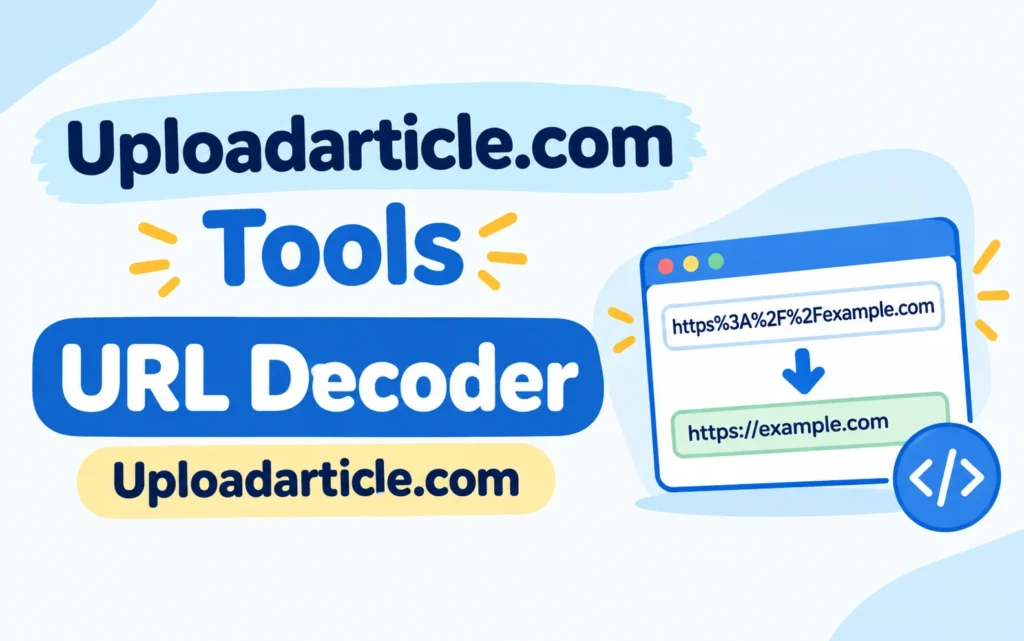
URL Decoder Uploadarticle.com, like Hello%20World%21, back into plain text, like Hello World!. Paste the encoded string into a decoder, run it, and read the result. If you need to do it in code, use decodeURIComponent() in JavaScript or urllib.parse.unquote() in Python.
This article explains how decoding works, which function to pick, and the mistakes that cause broken or misleading output.
What a URL Decoder Uploadarticle.com Does
URL Decoder Uploadarticle.com can only safely carry a limited set of characters. The URL standard (RFC 3986) treats letters, digits, and the symbols -, ., _, and ~ as safe. Everything else, such as spaces, accented letters, and many symbols, must be written as a percent sign followed by two hexadecimal digits.
A space becomes %20. A question mark inside a value becomes %3F. A URL Decoder Uploadarticle.com reverses this. It finds each %XX group and swaps it for the character it stands for.
This matters because encoded text is hard to read. When you copy a link from an analytics report, a server log, or a redirect chain, you often see long strings full of percent codes. Decoding shows you what the link actually says.
How to Decode a URL in 5 Steps URL Decoder Uploadarticle.com
- Copy only the part you need. If you want to read a search term, copy the value after
q=, not the whole link. - Paste it into the URL decoder input box.
- Run the decode action.
- Check the output. Look for leftover
%signs. If you see%25, the text was encoded twice. - Decode again only if needed. Do this once per layer of encoding, and stop when no percent codes remain.
Common Percent-Encoded Characters
| Encoded | Character | Where you see it |
|---|---|---|
%20 |
Space | File names, paths, query values |
%21 |
! |
Search terms |
%22 |
" |
Exact-match search phrases |
%23 |
# |
Fragments and tracking values |
%25 |
% |
The percent sign itself, also a sign of double encoding |
%26 |
& |
Values that contain an ampersand |
%2B |
+ |
Literal plus signs |
%2F |
/ |
Slashes inside a parameter, such as redirect URLs |
%3A |
: |
https%3A%2F%2F in redirect parameters |
%3D |
= |
Values containing an equals sign |
%3F |
? |
Question marks inside values |
%40 |
@ |
Email addresses in parameters |
A Before and After Example
Here is an encoded link:
https://example.com/search?q=caf%C3%A9+au+lait&city=New%20York%20%26%20CoDecoded values:
q=café au laitcity=New York & Co
Two things are worth noticing:
- Accented letters take more than one code. The letter é is
%C3%A9because it is stored as two bytes in UTF-8. A good decoder reads those bytes together as UTF-8 and returns one character. - The
+incaf%C3%A9+au+laitmeant a space. The&inNew York %26 Cois part of the value, not a separator between parameters.
Why You Should Not Decode a Whole URL Blindly
If you decode the full link above in one go, %26 turns into &. Now the text reads city=New York & Co, and anyone parsing that string will think Co is a new parameter. The meaning has changed.
So the safer habit is to split first, then decode each value. Use the full-URL decode only to read the link, not to reuse it. If you need a working link, keep the original encoded version.
%20 vs +: What Is the Difference?
Both can mean a space, but only in certain places.
%20means a space anywhere in a URL.+means a space only in query strings submitted as form data (theapplication/x-www-form-urlencodedformat used by HTML forms).- In a URL path, a
+is just a plus sign.
This is why some decoders have a separate option for plus signs. If your output shows caf%C3%A9+au+lait turning into café+au+lait, the decoder did not treat + as a space. Use the form-style decode option, or replace plus signs with spaces first.
Which Decode Function Should You Use?
| Language | Function | Notes |
|---|---|---|
| JavaScript | decodeURIComponent() |
Best for single values. Decodes everything, including %2F and %26. |
| JavaScript | decodeURI() |
For whole URLs. Leaves reserved characters like %2F and %3F encoded. |
| Python | urllib.parse.unquote() |
Decodes %XX. Leaves + alone. |
| Python | urllib.parse.unquote_plus() |
Also turns + into a space. Use for form data. |
| PHP | rawurldecode() |
Follows RFC 3986. Keeps + as a plus. |
| PHP | urldecode() |
Turns + into a space. |
| Java | URLDecoder.decode(str, UTF_8) |
Form-style. Turns + into a space. |
The MDN documentation for decodeURIComponent and the official Python and PHP docs describe these behaviors in full. If you are decoding query values, the “component” or “plus” versions are usually what you want. If you are decoding a full address just to read it, decodeURI() is the gentler choice.
Fixing Common Decoding Problems URL Decoder Uploadarticle.com
You still see %25 after decoding.
The text was encoded twice. %2520 decodes to %20, which decodes to a space. Decode once more.
You get strange characters like é.
This is an encoding mismatch. The text was encoded in one character set (usually UTF-8) and read as another (like Latin-1). Set your decoder to UTF-8.
You get an error such as “URI malformed.”
In JavaScript, decodeURIComponent('%') throws a URIError because % must be followed by two hex digits. A stray % in the text, a truncated string, or invalid UTF-8 byte sequences all cause this. Check where the string was cut off, or encode the lone % as %25 first.
The decoded link does not work.
Decoding is for reading. A decoded URL with spaces or & inside values can break when pasted into a browser or an API call. Use the original.
Is It Safe to Decode Unknown Links?
Decoding text is safe in itself, because it only changes how the characters are shown. The risk is what you do next. Encoded links can hide a destination, for example a redirect parameter like url=https%3A%2F%2Fexample.org. A quick safety checklist:
- Decode to read the link, but do not open it if the destination looks wrong.
- Check the domain after the URL Decoder Uploadarticle.com
https://. - Be careful with long encoded strings in unexpected emails.
- Do not paste private tokens or session IDs into any online tool, since you cannot see how it handles your input.
Developers should also know that decoded input is untrusted input. Anything URL Decoder Uploadarticle.com should be validated before it goes into a database query, file path, or HTML page.
URL Decoder Uploadarticle.com vs URL Encoder
They are two halves of the same job. An encoder makes text safe to place inside a URL. A decoder makes it readable again. A simple test is to encode a string, then decode it. You should get the original text back. If you do not, something in your process is encoding or decoding twice, or using the wrong character set.
When Decoding Helps in Real Work
- Reading UTM and campaign parameters in analytics exports.
- Checking redirect chains and canonical URLs during an SEO audit.
- Reading search queries in server logs.
- Cleaning file names that contain
%20. - Debugging API requests where a parameter arrives garbled.
Frequently Asked Questions About URL Decoder Uploadarticle.com
Does decoding change the actual link?
No. The original link stays the same. You only see a readable version of it.
Can I decode a link that is not encoded?
Yes. If there are no percent codes, the output matches the input.
Why do some letters need three or more codes?
Non-English letters, symbols, and emoji use multiple bytes in UTF-8, and each byte gets its own %XX. An emoji can need four.
Is percent-encoding the same as Base64?
No. Base64 is a different scheme and looks like random letters and numbers, often ending in =. A URL decoder will not turn Base64 into readable text.
Thankyou For Reading
- Open All Urls by Alaikas: 7 Smart Tab Tricks You Can Use Today
- Privacy Policy Generator by Alaikas: 7 Essential Checks
- Veganizoo Guest Posting: Is It Worth It in 2026?
Find the latest Antutu rankings and benchmark results in one place on The Antutu Score.